China launches Shenzhou 24 with first foreign astronaut from Pakistan
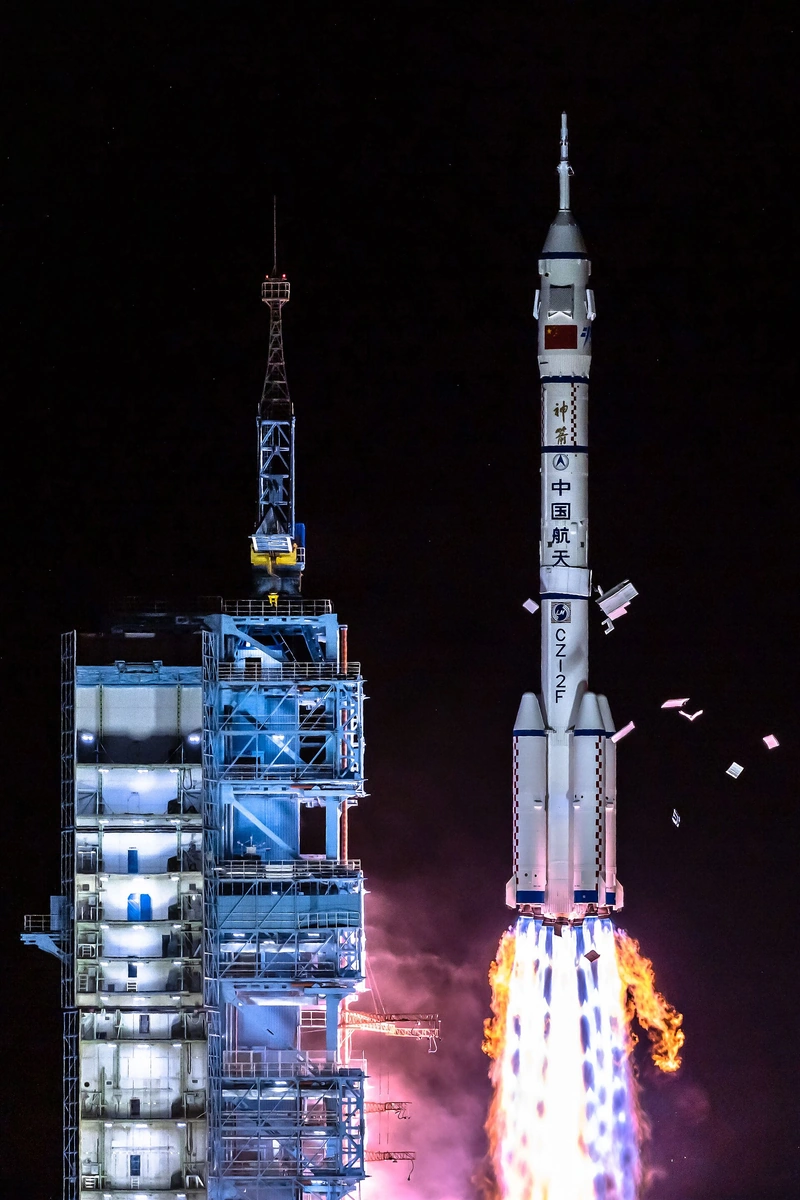
China launched Shenzhou 24 on Wednesday from Jiuquan with three astronauts, including Pakistan's Muhammad Zeeshan Ali, the first foreign national to fly in China's manned space programme. The crew will conduct over 90 experiments aboard the Tiangong space station.
China launched the Shenzhou 24 spacecraft on Wednesday from the Jiuquan Satellite Launch Centre in northwestern China, carrying three astronauts, two Chinese and one Pakistani, in the first joint flight with a foreign crew member in the history of the country's manned space programme.
The Long March 2F rocket lifted off in the morning and the craft successfully separated from the launch vehicle, entering its predetermined orbit, state media reported. Pakistani astronaut Muhammad Zeeshan Ali, 40, is flying alongside Chinese astronauts Tang Hongbo, 51, and Wu Yi, 39.
The mission stems from an agreement signed by China and Pakistan in February 2025 to cooperate on human spaceflight. Hours before lift-off, crowds gathered at the launch centre for a send-off ceremony, many filming the moment on their phones as the crew departed for the Tiangong space station.
The crew will conduct more than 90 scientific experiments and technology tests during their stay aboard Tiangong, the official Xinhua news agency said. Ali will carry out a photosynthetic cyanobacteria experiment during his short-term mission and is expected to return to Earth aboard the Shenzhou 23 spacecraft.
This is the first spaceflight for both Ali and Wu, while Tang has flown twice before and is set to become the first astronaut to board Tiangong three times, national broadcaster CCTV reported. Tang previously flew on Shenzhou 12 in 2021 and Shenzhou 17 in 2023, accumulating extensive experience on the station.
At a news conference on Tuesday, Tang said differences in language, culture and psychology had made learning to work together more challenging on this mission, but that both sides' efforts were paying off. The crew demonstrated their coordination during the briefing, with Ali addressing reporters in Mandarin.
Ali quoted a line of Chinese poetry about climbing one storey higher to see farther, saying in Mandarin: "It's like my daily training. Day after day, reaching new heights." Speaking in English, he said he hoped the next chapter of space cooperation between the two countries would expand from one astronaut on one flight to multiple joint missions and eventually to the Moon, Mars and beyond.
Pakistani Prime Minister Shehbaz Sharif offered his best wishes ahead of the launch. On X on Tuesday he wrote: "Pakistan-China friendship is surpassing the heights of the Himalayas in its journey to outer space." The statement underscored the symbolic weight of the mission for bilateral ties.
China launched Shenzhou 23 in May with three astronauts, one of whom was slated to remain in orbit for about a year. That crew is currently aboard Tiangong and will welcome the Shenzhou 24 astronauts for a brief handover period before Ali returns on Shenzhou 23.
Beijing is preparing for its first crewed lunar landing by 2030, with the Tiangong programme serving as a testbed for life-support and operational technologies. The United States, widely seen as China's main space rival, is targeting a crewed Moon landing under NASA's Artemis programme in 2028.
The Shenzhou 24 mission represents a new phase in China's international space cooperation. While Chinese astronauts have previously flown with European and Russian counterparts on other vehicles, this is the first time a foreign national has been integrated into a Shenzhou crew and the Tiangong expedition framework.
Analysts said the Pakistan flight signals China's willingness to open its station to partners outside the traditional space powers, particularly countries aligned with its Belt and Road Initiative. Pakistan's space agency, SUPARCO, has collaborated with China on satellite launches for decades, but human spaceflight marks a significant deepening of that relationship.
The cyanobacteria experiment Ali will conduct aims to study photosynthetic efficiency in microgravity, with potential applications for life-support systems on long-duration missions. The experiment was jointly designed by Chinese and Pakistani researchers under the 2025 agreement.
Over the coming days, Shenzhou 24 will perform an automated rendezvous and docking with the Tiangong core module. The crew will then enter the station, begin experiment operations, and conduct joint activities with the Shenzhou 23 crew before the latter's departure.
The mission duration for Ali is expected to be shorter than a standard six-month expedition, reflecting the short-term nature of the cooperative flight. Tang and Wu will remain aboard Tiangong for the full expedition, conducting maintenance, science, and technology demonstrations.
China's manned space agency has indicated that further international cooperative flights are under discussion, with several countries expressing interest in sending astronauts to Tiangong. The station, completed in 2022, is the only operational space station besides the International Space Station.
You may like

Bengal Commercial Bank partners with Dhaka North City Corporation
November 25, 2026

Meta faces legal action from Kenyan moderators over PTSD and AI layoffs
November 25, 2026

West Bengal minister says India will take Bangladesh by December 16
November 25, 2026

Last time IPL said NO This year Mustafiz says NO to IPL
November 25, 2026
Elected News
-

Bangladesh Seeks UN Women Support on Digital Harassment and Women’s Empowerment
-

Bangladesh, Australia Discuss Human Trafficking, Irregular Migration and Rohingya Crisis
-

Bangladesh Plans Internet-Free Access to Mobile Banking and Financial Apps
-

DU to Open Undergraduate Admission Applications on 11 November, Tests Begin 5 December


